
The Golf Game You Think You Have vs. the Golf Game You Actually Have
Every golfer has a theory about their own game. You might tell people you are a good ball striker but can't putt. You might think your driver is the reason you can't break 80. You might describe yourself as inconsistent, say you hit your irons too high, or insist that you simply need a little more distance. These beliefs usually don't come from nowhere. They are built from hundreds of rounds, range sessions, memorable shots and the occasional spectacular disaster.

The problem is that golfers are not always particularly good at diagnosing themselves.
We remember the drive that went 30 yards farther than usual. We remember the three-putt that cost us a hole. We remember the perfect seven-iron and the ugly one that flew over the green. Over time, those memories become part of the story we tell ourselves about our game. But the story can be very different from the underlying reality.
And that difference matters, because you can spend a lot of time trying to fix a problem that isn't actually your biggest problem.
Golfers See the Shots. They Don't Always See the Pattern.
Golf is an unusual sport because the feedback is immediate but the explanation often isn't.
You know when the ball goes into the trees. You know when you hit a thin iron. You know when a putt misses the hole. What you don't necessarily know is why those things keep happening, how often they actually happen, or whether they matter as much to your score as you think they do.
A golfer might say, "I can't hit my driver," after three poor drives in a round. But what does that really mean? Are the misses consistently left? Are they starting left and curving farther left? Are they actually in play most of the time but costing distance? Is the golfer hitting the center of the face but delivering the club in a way that creates an unwanted ball flight? Or is the driver perfectly adequate and another part of the game causing far more damage?
The same problem exists throughout the bag.
"I can't hit long irons."
"My wedges are terrible."
"My putting is killing me."
"I need more distance."
These statements may all contain some truth. But they are descriptions of a golfer's experience, not necessarily a diagnosis of the golfer's game.
Your Handicap Doesn't Tell the Whole Story
A handicap is useful because it gives golfers a common language for performance. But it doesn't tell you how someone gets to that number.
Two golfers can have the same handicap while playing remarkably different games. One might drive the ball well but struggle around the green. Another might be short off the tee but exceptionally consistent with approach shots. One might make relatively few double bogeys but rarely make birdies. Another might produce spectacular holes and then give shots back with one or two big mistakes.
Their handicap may be similar.
Their golf games are not.
This is one reason broad categories can be so limiting. Saying that someone is a 10-handicap, for example, gives you useful information, but it doesn't tell you what that golfer should practice tomorrow. It doesn't tell you whether their driver is properly fitted. It doesn't tell you which clubs they strike consistently. It doesn't tell you what their typical miss looks like or whether their equipment is helping or hindering them.
The number describes an outcome.
It doesn't necessarily explain the golfer behind it.
AI Can Start With the Golfer, Not the Assumption
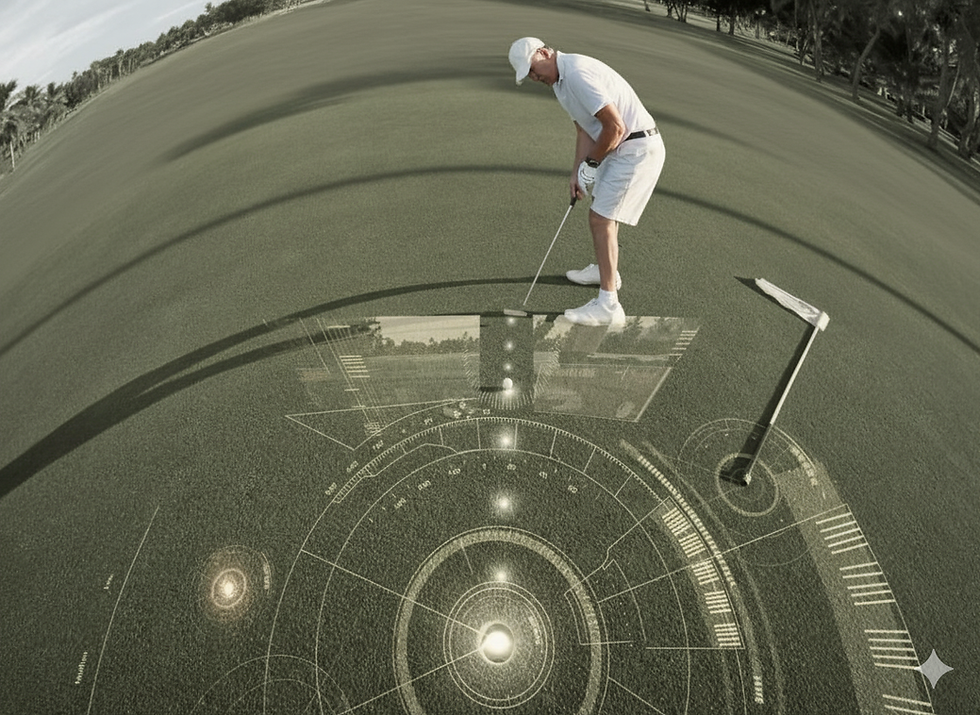
This is where AI can make golf analysis much more interesting.
Instead of beginning with an assumption about what a golfer is supposed to need, an AI golf system can begin by collecting information about the individual. Physical characteristics, equipment, swing information, distances, scoring patterns, strengths, weaknesses and goals can all become part of the picture.
The more complete the picture becomes, the harder it is to reduce the golfer to a single label.
That matters because context changes the answer. A golfer who says they need more distance may actually need better launch conditions. A golfer who thinks they need a new driver may discover that their current driver isn't the biggest issue. A golfer who believes they need to rebuild their swing may discover that a particular equipment characteristic is contributing to the problem.
AI doesn't have to assume the golfer is correct about the cause.
It can start by asking what is actually happening.
The Conversation Is Part of the Intelligence
There is another advantage to AI that is easy to overlook.
Golf is full of questions that don't fit neatly into a search box.
A golfer might ask, "Why do I hit my seven-iron so well but struggle with my five?" Then, after receiving an answer, the next question might be, "What if I replaced my five-iron with a hybrid?" Then another question follows: "Would that change what I should practice?"
Those aren't three separate golf problems. They are part of one conversation about the golfer's game.
A conversational AI system can follow that context. It can use what the golfer has already provided and continue exploring the issue rather than forcing the golfer to start over with another generic search.
That is an important shift. Instead of consuming isolated pieces of golf advice, the golfer can have a conversation about their own game.
And the more specific the questions become, the more useful the conversation can become.
Sometimes the Answer Is Not What You Expected
One of the most valuable things about objective analysis is that it can challenge your assumptions.
That doesn't mean the golfer is always wrong. In many cases, golfers know their games extremely well. They know which holes make them uncomfortable, which clubs they trust and which shots they fear. Their experience is valuable information.
But experience has limitations too.
Golfers can become accustomed to a particular weakness. A player who has sliced the ball for ten years may simply think of slicing as part of their identity. Someone who has always struggled with long irons may assume that they are "just not a long-iron player." A golfer who has always hit a certain type of ball may never question whether it is actually the right ball for them.
Sometimes the most useful question isn't, "How do I get better at the thing I already know is wrong?"
It is, "What if the thing I think is wrong isn't the real problem?"
That question opens up an entirely different way of looking at improvement.
Your Equipment Can Reinforce Your Assumptions
This becomes particularly interesting when you look at what golfers keep in their bags.
Equipment often has a long history with its owner. A driver might have been purchased because it was highly recommended. A set of irons might have been bought five years ago after a 20-minute fitting. A golf ball might have been chosen because a Tour player uses it. Over time, the golfer adjusts to the equipment and starts thinking of its characteristics as characteristics of their own swing.
But those aren't necessarily the same thing.
If a golfer consistently launches the ball too low, that may be a swing issue, an equipment issue or both. If their miss is consistently one direction, the club's specifications may be relevant. If their distances have changed, the original fitting may no longer describe the golfer who is using the clubs today.
This is why a good fitting isn't simply about finding a club that feels good during a few swings. It is about understanding the relationship between the golfer and the equipment.
The golfer changes.
The equipment doesn't.
Unless you reassess the relationship, you can spend years assuming that something is a permanent characteristic of your game when it may simply be the result of an old decision.
Understanding Your Game Can Be More Valuable Than Another Tip
Golfers don't necessarily need more information.
They need information that makes sense in the context of their own game.
That is a fundamentally different proposition. There are already thousands of golf tips available online. There are endless equipment reviews, swing videos, fitting charts and practice drills. The problem isn't finding another piece of information. The problem is knowing whether that information applies to you.
That is where personalized AI can become useful for everyday golfers.
You can input your profile, your equipment and information about how you play. The system can use that information to produce a fitting analysis and practice recommendations built around you rather than an imaginary average golfer. You can then ask questions, explore alternatives and continue the conversation as your game develops.
The technology doesn't have to replace your own judgment.
It can give your judgment better information to work with.
The First Step Toward Better Golf May Be Knowing Yourself Better
Every golfer has a picture of the player they believe they are.
The better ball striker. The inconsistent driver. The great iron player. The terrible putter. The golfer who needs more distance. The golfer who just needs to stop making stupid mistakes.
Some of those descriptions will be accurate.
Some won't.
The opportunity with AI is to make that picture more precise. Instead of relying entirely on memory, frustration and the occasional great shot, golfers can begin building a more complete understanding of how they actually play. They can connect their physical profile, equipment, performance and goals and start seeing the game as a whole rather than as a collection of isolated problems.
That may be one of the most important changes AI brings to golf.
Not simply giving golfers more answers.
Helping them ask better questions about themselves.
Because before you can decide what to change, you have to understand what you actually have.


Comments