
AI Fitting Is What You Should Practice Today?
For most golfers, the hardest part of practice is not finding something to do. It is deciding what is actually worth doing. Walk into any driving range and you will see the same pattern: a golfer hits a few drivers, moves to irons, tries some wedges, maybe finishes with a few putts, and then goes home. It feels like practice because a lot of golf balls were hit. But hitting golf balls and improving your golf game are not necessarily the same thing.
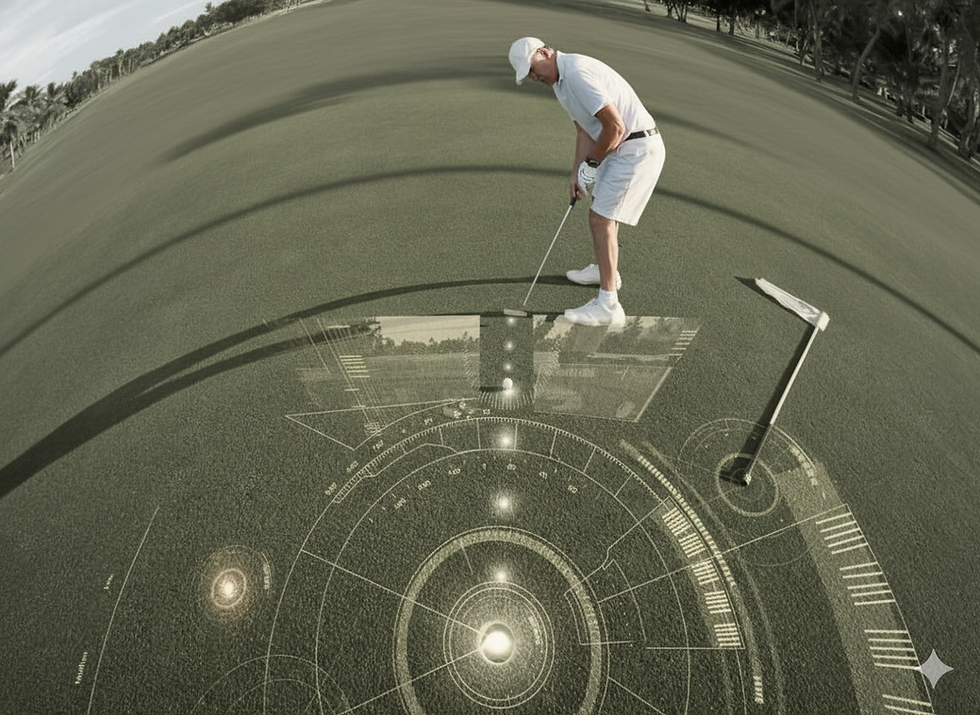
The problem is that most golfers are left to make that decision themselves. Maybe you watched a video about fixing your slice. Maybe you had three bad holes last weekend and decided your short game needs work. Maybe you bought a new driver and want to see whether you can hit it farther. None of those things are necessarily wrong, but they may not be the most important thing for your game right now. The difference between practice that feels productive and practice that actually moves your game forward often comes down to one question: what should you be working on today?
Your Golf Game Is Giving You Clues
Every round contains information about what is happening in your game. How often you miss the fairway. Where your approach shots finish. How many greens you hit. What happens when you miss a green. How many putts you take. Whether your misses tend to go in the same direction. Even the clubs you feel uncomfortable hitting can provide useful information.
The challenge is turning all of those observations into a plan. A golfer might know that they are inconsistent with their irons, for example, but that does not tell them what to practice. The problem could be contact, distance control, face angle, strike location, inconsistent setup, an equipment issue, or simply choosing a shot that does not fit their capabilities. Practicing more iron shots without understanding which of those factors is involved can easily become an exercise in repetition rather than improvement.
This is where AI introduces a different way of thinking about practice. Instead of starting with a generic drill and asking whether it might help, the process can start with the golfer. Your physical profile, handicap, scores, shot patterns, equipment, swing characteristics and practice goals can all provide context. The objective is not simply to give you another golf tip. It is to use the information about your game to determine what deserves your attention.
Practice Can Become Personal
Consider two golfers with the same handicap. One loses most of his strokes from inside 100 yards. The other hits plenty of good approach shots but struggles to keep the ball in play off the tee. Telling both golfers to “work on their short game” because they are both 12 handicaps would make little sense. Their handicaps are similar, but their games are not.
Personalized practice changes the starting point. Instead of asking what golfers at a particular handicap normally struggle with, AI can look at the individual golfer's information and build a practice plan around it. That might mean more wedge distance-control work for one golfer, driver dispersion work for another, putting drills for a third, or a combination of several areas where the data suggests there is an opportunity to improve.
The important distinction is that personalization does not mean simply creating a different list of drills for every golfer. A useful practice plan should explain why an activity has been selected, what the golfer is trying to accomplish, how many repetitions to complete, and what a successful result looks like. It turns practice from “hit 20 balls” into something measurable. You are no longer just doing an exercise. You know what you are trying to change.
The Best Practice Plan Can Change
Golfers also have a tendency to treat their practice plan as permanent. They identify a weakness, work on it for several weeks and continue doing the same thing because that was the original plan. But golf does not stay still. Your swing changes. Your confidence changes. Your equipment changes. Your course conditions change. Your strengths and weaknesses can change as you improve.
That makes an ongoing feedback loop more useful than a static practice schedule. If your driver dispersion improves, there may be less reason to spend the majority of your practice time on it. If your wedge distance control remains inconsistent, that may deserve more attention. If your putting numbers improve but your approach-shot performance declines, the balance of your practice may need to change again.
This is one of the more interesting possibilities with AI in golf. The technology does not have to provide one answer and stop. It can continue the conversation. You can tell it what happened in your last round, provide updated statistics, describe a miss you are seeing, upload swing information or explain what felt different during your practice session. The recommendation can then evolve with the golfer.
What Should You Practice Today?
That question sounds simple, but it is actually one of the most important questions in golf improvement. Most golfers have limited time. They might have 30 minutes before work, an hour at the range on a weekend, or a short window after playing nine holes. When practice time is limited, deciding what not to practice becomes almost as important as deciding what to practice.
AI can help make that decision more objective. Rather than choosing the next drill because it appeared in a social media feed or because it worked for another golfer, you can start with your own game and work backward. What is costing you shots? What is realistically changeable? What skill would have the greatest practical impact? What should you measure? And once you improve, what should come next?
That does not mean AI replaces a good golf professional. A qualified coach can see and interpret things that may not be captured in a data set, particularly when working with a golfer in person. Instead, AI can give golfers another layer of intelligence between lessons and practice sessions, helping them understand their own information and turn it into a more structured plan.
The Big Brain in Golf Is Becoming Practical
This is ultimately what makes AI interesting for everyday golfers. The breakthrough is not simply that a computer can talk about golf. Golfers already have access to more golf information than ever before. The breakthrough is the possibility of taking all of that information and making it relevant to one specific golfer.
That is the idea behind golfgaim. You start by providing information about yourself, your equipment and your game. From there, the platform can generate personalized fitting and practice recommendations rather than sending you toward generic advice designed for the average golfer. Your equipment and your practice are connected because the clubs in your hands influence the shots you are trying to produce, while the shots you produce provide information about what may need to change.
For years, golfers have had to assemble their own golf intelligence. A lesson from one person, a club fitting from another, a YouTube video, some launch-monitor numbers, a scorecard and a pile of opinions from other golfers. AI creates the possibility of bringing those pieces together into one ongoing conversation about your game.
The question is no longer simply whether you should practice. Of course you should. The more interesting question is whether the limited time you have to practice is being spent on the things that matter most to your golf game.
The big brain in golf is here. And increasingly, the smartest place to start may be with a much simpler question: What should I practice today?


Comments