The Death of Guesswork: How AI Is Changing Club Fitting Forever
AI Golf Fitting vs. Conventional Fitting - A 20 day discussion
For most of golf's history, buying new clubs has involved a surprising amount of guesswork. Golfers have relied on recommendations from friends, advice from the local golf shop, online reviews, manufacturer fitting charts or whatever happened to be winning on the PGA Tour that week.
While those sources can provide useful guidance, they all share one fundamental limitation. They're based on generalized assumptions rather than a complete understanding of the individual golfer. In a game where fractions of a degree in clubface angle can determine whether a drive finds the fairway or disappears into the trees, relying on educated guesses has never been an ideal approach. Today, that is beginning to change, and artificial intelligence is leading the transformation.
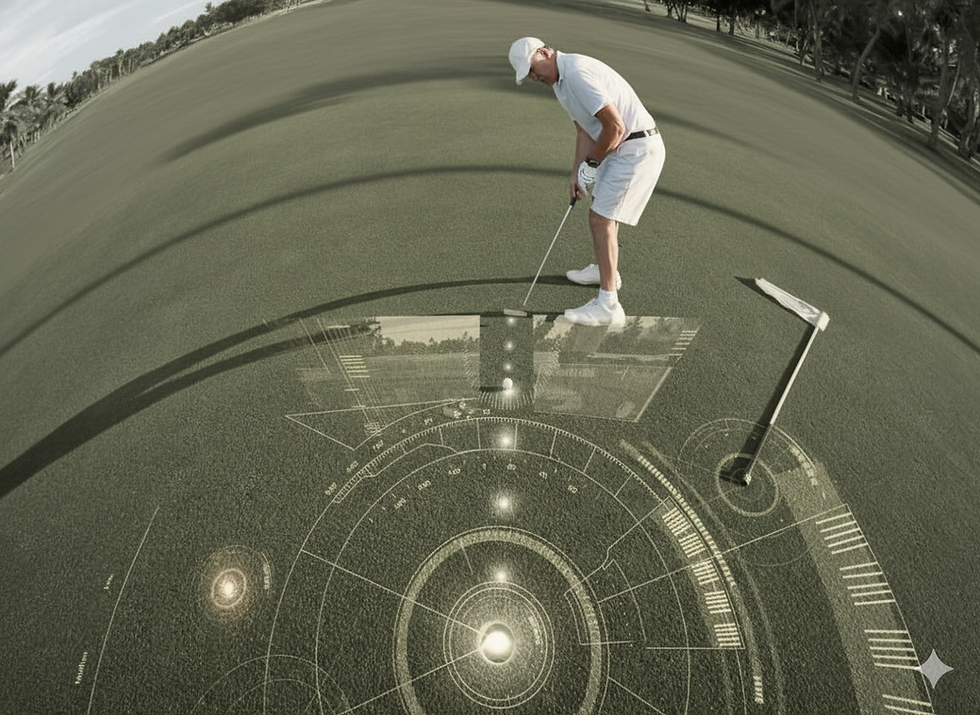
Club fitting itself is not a new concept. For decades, professional fitters have helped golfers find equipment that better matches their swings by analyzing launch monitor data, observing ball flight and drawing on years of experience. A quality fitting remains one of the best investments a golfer can make because properly matched equipment can improve consistency, distance and confidence. However, even the best traditional fitting has practical limitations. It captures your swing on a single day, usually over the course of an hour or two, and relies on the fitter's ability to interpret a large amount of information in real time. It's an impressive process, but it is still a snapshot rather than a complete picture.
Day 9 - How AI Is Changing Club Fitting Forever
The golf swing is far more complex than most golfers realize. Swing speed is only one variable among dozens that influence how a club should be built. Tempo, transition, release pattern, attack angle, strike location, face delivery, physical characteristics, flexibility, current equipment and even long-term improvement goals all play important roles in determining the ideal specifications. Two golfers can produce nearly identical launch monitor numbers while arriving there through completely different swing mechanics. Traditional fitting can identify many of these differences, but artificial intelligence has the ability to evaluate them simultaneously and uncover relationships that would be difficult for any human to recognize consistently.
Perhaps the greatest advantage of AI is that it has no preconceived opinions. It doesn't assume a golfer should play a particular shaft because they swing over a certain speed, nor does it recommend a specific iron simply because another player with the same handicap had success using it. Instead, AI evaluates the golfer as an individual. Every recommendation begins with data rather than assumptions, allowing the fitting process to become significantly more personalized than traditional category-based approaches. Instead of asking what clubs most golfers should play, AI asks what clubs are most likely to help this golfer perform better.
This level of personalization mirrors the approach taken by the world's best players. Inside PGA Tour equipment trucks, club fitters and engineers constantly analyze player performance using sophisticated launch monitors, high-speed cameras and extensive testing. Professionals rarely change equipment based on marketing claims or product release dates. Every adjustment is supported by measurable performance improvements. If a new shaft tightens dispersion, it stays in the bag. If a different driver head produces better launch conditions, it earns its place. If nothing performs better than the current setup, nothing changes. Decisions are based on evidence, not excitement.
Until recently, that level of analysis was largely unavailable to recreational golfers. Most players simply didn't have access to tour-level equipment technicians or the time required for repeated testing sessions. Artificial intelligence is helping close that gap. By processing large amounts of swing and equipment data, AI can identify patterns that extend well beyond what happens during a single fitting session. It can recognize how physical characteristics influence equipment selection, how changes in tempo affect shaft performance and how evolving swing mechanics may alter equipment needs over time. The result is a fitting process that becomes smarter with every new piece of information.
Another significant advantage of AI is its ability to remove emotional bias from equipment decisions. Golfers are naturally influenced by advertising, tour victories and brand loyalty. It's easy to believe that the newest driver must outperform the one already sitting in your bag or that copying the equipment of your favourite professional will somehow produce similar results. AI has no interest in brand names or marketing campaigns. It doesn't care which manufacturer produced the club or whether it was released last month or three years ago. It simply evaluates which equipment is most likely to improve your performance based on measurable evidence.
This shift also changes the economics of golf equipment. Modern drivers regularly sell for well over CAD $800, and premium iron sets often represent investments of several thousand dollars. Those purchases may absolutely be worthwhile when new equipment genuinely provides a performance advantage. However, AI often identifies situations where smaller adjustments produce equally meaningful improvements. A shaft replacement, loft adjustment or lie angle modification may deliver more consistent results than replacing an entire set of clubs. Instead of encouraging golfers to spend more, AI encourages them to spend more intelligently.
As artificial intelligence continues to evolve, club fitting itself will become an ongoing process rather than a one-time event. Your golf swing is constantly changing as you take lessons, improve your fitness, recover from injuries or simply gain experience. Equipment that fit your game three years ago may no longer represent the best option today, even if the clubs themselves remain in excellent condition. AI has the ability to monitor those changes and update recommendations as your game evolves, creating a fitting process that grows alongside the golfer instead of remaining frozen at a single moment in time.
There are already signs that this transformation is accelerating throughout the golf industry. Launch monitor technology continues to become more sophisticated, equipment databases are expanding rapidly and artificial intelligence is being integrated into more aspects of swing analysis and performance evaluation. The next generation of club fitting won't replace experienced fitters. Instead, it will provide them with better tools, deeper insights and more comprehensive analysis than ever before. Golfers will ultimately benefit from the combination of human expertise and artificial intelligence working together rather than competing with one another.
At golfgaim, we believe the future of club fitting is not about replacing people. It's about replacing guesswork. Our AI-powered fitting platform analyzes dozens of variables that influence how your equipment performs, delivering recommendations based on your unique swing rather than broad assumptions or marketing trends. Every golfer deserves equipment that is selected with the same attention to detail that professionals receive on tour. Because the future of golf isn't about buying more clubs. It's about making smarter decisions, and artificial intelligence is making those decisions more accurate than ever before.


Comments